With the Indo-Pak dialogue in tatters and the respective armies exchanging fire across the Line of Control, an unexpected opportunity has presented itself for boosting trade between the two countries.
As part of the exercise, each family will get complete ownership of the businesses it manages while scrapping the holding company.

'In terms of semiconductors, challenges do remain in the pan industry, but I think we are much better than where we were a year or so back.'

If Tesla comes in, India's position as a manufacturing hub will rise many notches, as it will become only the second country, after China, to have both Apple as well as Tesla.

Whether it's Carrefour, Ford, or other foreign majors, they are ready to adjust their strategies and design their plans in a way that would address the Indian consumption story.

Commerce and Industry Minister Piyush Goyal has visited the manufacturing facility of US-based electric vehicle major Tesla at Fremont, California and said that the company would be doubling its auto components imports from India. The minister is in the US on a four-day visit. The world's largest electric car producer Tesla Inc's chief Elon Musk met Prime Minister Narendra Modi in June in New York and after the meeting Musk had said that he planned to visit India in 2024.

Major carmakers, including Maruti Suzuki, Hyundai, Tata Motors on Friday reported growth in their passenger vehicle sales in June as semiconductor shortage woes showed gradual signs of easing out. Other manufacturers, Kia India, MG Motor India and Skoda Auto India also reported robust sales growth last month. Maruti Suzuki India (MSI) reported 5.7 per cent increase in total wholesales at 1,55,857 units in June as compared to 1,47,368 units to dealers in June 2021.

Its executives are test-marketing the model in New Delhi.

Despite the robust growth in this country, Apple's India share in its overall global sales remained modest -- constituting 1.5 per cent of its overall turnover of $389 billion in FY23.

The first leg of the 35-day festive period, which ended with Dussehra, failed to bring any cheer for auto companies. While makers of passenger vehicles struggled to meet demand due to the persistent shortage of semiconductors, a recovery in demand remained elusive for two-wheeler manufacturers despite offers and schemes. The overall season, which ends two days after Diwali, is unlikely to bring any turnaround in either the supply or the demand scenario, said dealers and officials at auto companies.

China's covid crisis could provoke a raw material crunch for India's EV industry later this year.


'Two would be premium products and three would be mainstream products.'

With Donald Trump all set to become US president, Indian exporters may face high customs duties for goods like automobiles, textiles and pharmaceuticals if the new US administration decides to pursue the 'America First' agenda, opined trade experts. Experts also said that Trump could also tighten H-1B visa rules, impacting costs and growth for Indian IT firms. Over 80 per cent of India's IT export earnings come from the US, making it vulnerable to changes in visa policies.

Stung by the government's punitive action on electric two-wheelers, registrations in April fell by nearly a fourth to 62,581 from 82,292 in March, according to data from VAHAN. Electric two-wheeler companies, including Okinawa, Hero Electric, Ather Energy, and TVS, have all clocked their lowest registrations in the four months of this calendar year. Ola Electric has been the only exception to this bloodbath, and has crossed its March numbers, hitting 21,560 registrations in April, which is its highest in this calendar year. As a result, there have been some interesting changes in the electric two-wheeler pecking order.

Even as India's passenger-vehicle sales touched a record high of 3.9 million units in 2022-23, growing 27 per cent over the previous financial year, the country's largest carmaker, Maruti Suzuki India (MSIL), said on Monday uncertainties in the electronic-component supplies might affect production in FY24. MSIL said the shortage of electronic components had some impact on production in FY23. "The company took all possible measures to minimise the impact.
Shortages of chips will impact the car market

Unprecedented bribery charges, farewells, separation, failed union, monumental mergers and record-breaking IPOs, along with a healthy dose of online happenings in the form of spat and lessons in customer care, corporate India saw it all in 2024.

To be able to tide over the current crisis, automobile manufacturers have waged a war against all cost heads.

After years of giving free passes to counterparts from Korea, Japan, US in the Indian auto market, Chinese automakers had planned a major push to grab the fifth largest car market in the world. But the shutdown of factories and logistics hubs in the country following the outbreak of coronavirus is slowly constricting the business of Chinese auto majors which have recently entered India.

The growth momentum that started during the festival season is likely to sustain in the new year, reports Arindam Majumder.
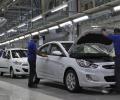
The government has decided to extend the Rs 25,938-crore production-linked incentive scheme for the automotive sector by one year, Union Heavy Industries Minister Mahendra Nath Pandey said on Tuesday. Post extension, the five-year scheme, originally in place from 2022-23 to 2026-27, will be active until 2027-28. At present, incentives are applicable under the scheme for determined sales of Advanced Automotive Technology (AAT) products (vehicles and components) manufactured in India from 1 April 2022 onwards for a period of five consecutive years.

Passenger vehicle dispatches from factories to dealers declined 13 per cent to the lowest level in five years in December last year as the industry continued to face production issues due to semiconductor shortage, auto industry body SIAM said on Friday. Passenger vehicle dispatches last month stood at 2,19,421 units compared to 2,52,998 units in December 2020. While acknowledging that the chip shortage situation is not expected to dramatically change in the short term, the industry body expressed hope that things will improve soon.

'We will see a lot of investments from the private sector.' 'As long as we are not impacted by some global events, I think we will be in a strong place.'
Major automobile manufacturers like Maruti Suzuki, Hyundai, Mahindra & Mahindra, Tata Motors and Toyota Kirloskar on Tuesday reported decline in domestic passenger vehicle sales in May compared to the previous month as a spike in COVID-19 cases and lockdowns across various states hit production and dispatches. The country's largest carmaker Maruti Suzuki India (MSI), which shut production from May 1 to May 16 so as to divert oxygen from industrial use for medical purposes, reported domestic dispatches to dealers at 35,293 units last month, down 75 per cent from 142,454 units in April. The company said sales of its mini cars, comprising Alto and S-Presso, declined by 81 per cent to 4,760 units in May as against 25,041 units in April this year.
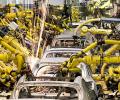
The passenger vehicle dispatches to dealers increased by 11 per cent in July as improvement in semiconductor supplies helped the companies to ramp up production ahead of the festive season, auto dealers' body SIAM said on Friday. Overall passenger vehicle wholesales increased to 293,865 units last month compared to 264,442 units in July 2021. Passenger car dispatches rose 10 per cent to 143,522 units in July from 130,080 units in the year-ago period.

Nifty50's earnings growth, estimated at 20 per cent by global research and brokerage firm Jefferies for financial year 2023-24 (FY24), will be amongst the top three in the Asian region, and is likely to outperform peers. Asean 40 index with 29.1 per cent estimated earnings growth and Straits Times Index (STI) with 29.1 per cent estimated earnings growth are the only two other indices in the Asian region that are likely to outperform India, suggests the recent Jefferies report, coauthored by Mahesh Nandurkar, their managing director along with Abhinav Sinha and Nishant Poddar.

India's gain will be an additional business of $300 million to $400 million per month if 10-11% of Bangladesh's export is diverted to Indian hubs like Tiruppur.

Durable goods companies and retailers say online sales won't compensate for the fall in offline sales.
Leading carmakers Maruti Suzuki, Hyundai and Tata Motors reported robust dispatches to dealers in May on the back of strong demand for passenger vehicles across regions, even as the global semiconductor shortage continued to impact production. Mahindra & Mahindra, Kia India, Toyota Kirloskar Motor, Honda Cars and Skoda also witnessed strong demand for their models last month. The month of May also witnessed Tata Motors race ahead of Hyundai in terms of domestic wholesales.

'At the heart of the strategic relationship between our countries are economic ties.'

Passenger vehicle wholesales in the country declined by 19 pc in November as the semiconductor shortage continued to impact vehicle production and subsequent deliveries to dealer partners, auto industry body SIAM said on Friday. The passenger vehicle (PV) dispatches last month stood at 215,626 units, down 19 per cent from 264,898 units in November 2020. Similarly, total two-wheeler sales declined sharply by 34 per cent to 10,50,616 units last month from 16,00,379 units in the year-ago period.

'Large-caps are better placed to withstand the impact of higher input cost inflation, rising rates and withdrawal of excess global liquidity.'

The global semiconductor shortage hit passenger vehicle sales in September, with major manufacturers like Maruti Suzuki, Hyundai and Mahindra & Mahindra reporting a decline in sales on Friday. Kia India and Honda Cars also reported a dip in wholesales last month as compared with the year-ago period. Carmakers like Tata Motors, Toyota Kirloskar Motor, Nissan and Skoda, however, reported an increase in passenger vehicle dispatches last month despite supply chain issues.

Passenger vehicle wholesales in India increased by 11.14 per cent to 2,76,554 units last month as compared with same month last year amid supply chain challenges, unavailability of semiconductors and higher container charges, auto industry body SIAM said on Thursday.
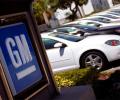
The move marks the entry of GWM, one of the largest manufacturers of sport utility vehicles (SUVs) and pick-ups, into the Indian market and a complete exit for GM from the country, two years after it stopped selling cars here.

The Reserve Bank of India's (RBI's) State of the Economy report for October acknowledged a slowdown in some high-frequency indicators but expressed confidence in a recovery, aided by consumption demand during the festival season. "In India, aggregate demand is poised to shrug off the temporary slowdown in momentum in the second quarter of 2024-25 as festival demand picks up pace and consumer confidence improves," said the report released on Monday.

Market leader Maruti Suzuki India's passenger vehicles sales declined by 2.34 per cent last month at 133,702 units. Hero MotoCorp reported total two-wheeler sales of 480,196 units last month, down 20.05 per cent.

ICICI Bank was the top gainer in the Sensex pack, soaring nearly 11 per cent, followed by Axis Bank, Dr Reddy's, SBI, M&M and Tech Mahindra. NSE Nifty advanced 10.50 points to 18,125.40.

Investors have gained Rs 335,770.71 crore in two days of market rally, with the Sensex scaling its fresh lifetime peak on Wednesday. Rising for the second day, the 30-share BSE benchmark jumped 476.11 points or 0.82 per cent to close at its new all-time high of 58,723.20. During the day, it gained 529.97 points to 58,777.06, its intra-day record.
